

This query returns auction events and the artists involved in them. By including URIs for particular artists, you can use it to filter for only those artists.
Introduction #
In 0001, users were shown how to proceed from events to artists (among other things). In theory, one could reverse this query to do the opposite. But this is not the recommended path, especially if we do not wish to reconstruct the results of particular auction_events. This is a simple query, moving from artist to sale_activity (and sale_sub_activity, as the user will see).
NB: The query must be limited in certain ways in order to avoid timing out at the SPARQL endpoint. There are simply too many possible artists to run through, with too many associated sale_activities. The query must either be limited using the LIMIT operator, as below, or by drilling down on particular artists (see commentary).
The relationship between artist, artwork, sale_activity, and sale_sub_activity is as follows.
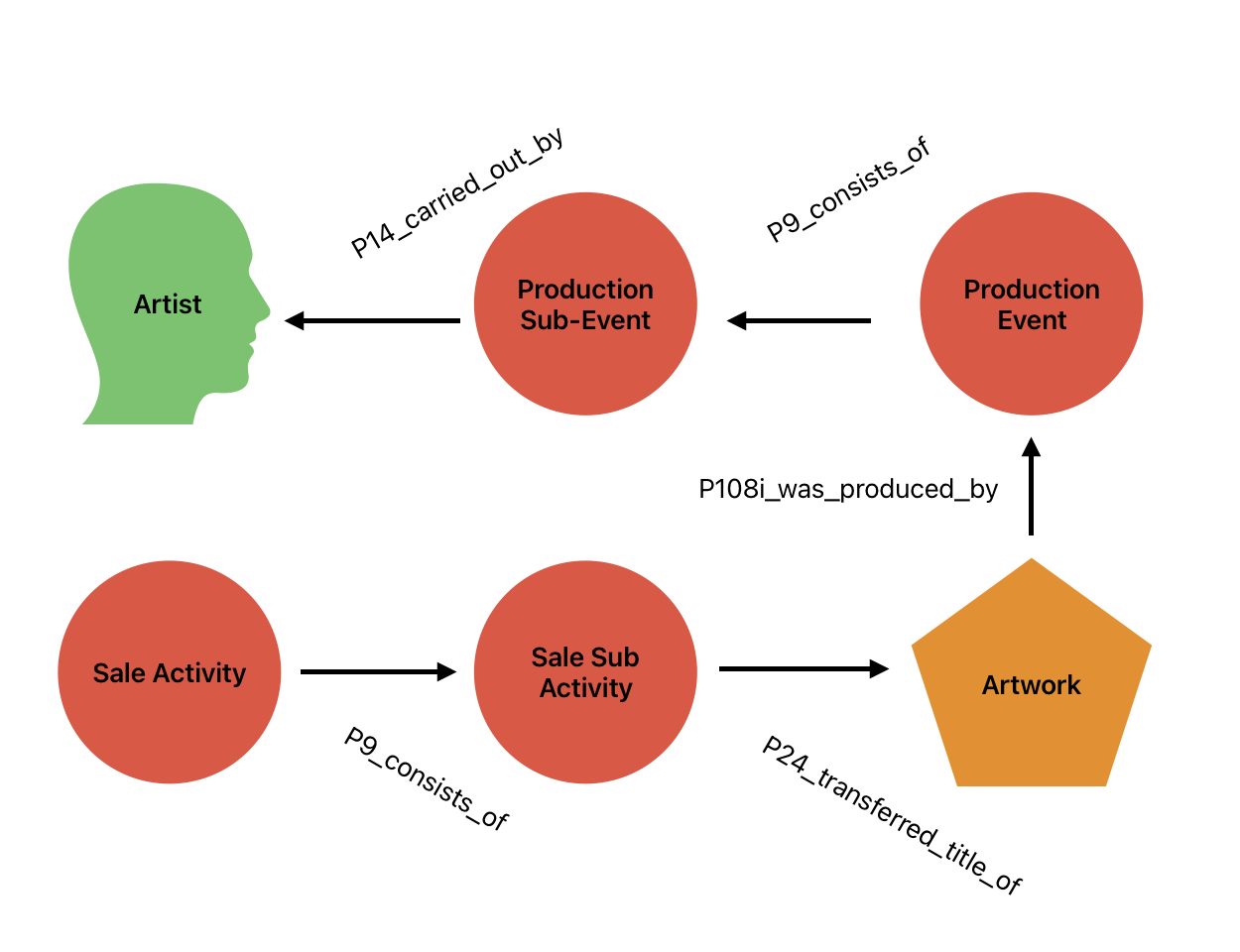
Query #
PREFIX skos: <http://www.w3.org/2004/02/skos/core#>
PREFIX la: <https://linked.art/ns/terms/>
PREFIX crm: <http://www.cidoc-crm.org/cidoc-crm/>
PREFIX rdf: <http://www.w3.org/1999/02/22-rdf-syntax-ns#>
PREFIX rdfs: <http://www.w3.org/2000/01/rdf-schema#>
SELECT ?artist_label ?artwork_name ?sale_activity_label ?sale_activity ?sale_sub_activity_label WHERE {
#  ?artist skos:exactMatch <http://vocab.getty.edu/ulan/500400787> .
  ?production_sub_event crm:P14_carried_out_by ?artist .
#  ?production_sub_event crm:P14_carried_out_by <https://data.getty.edu/provenance/8dd16496-278f-3bd3-8b1b-15e41195de61> .
  ?production_event crm:P9_consists_of ?production_sub_event .
  ?artwork crm:P108i_was_produced_by ?production_event .
  ?artwork crm:P1_is_identified_by ?artwork_identifier .
  ?artwork_identifier crm:P2_has_type <http://vocab.getty.edu/aat/300404670> .
  ?artwork_identifier crm:P190_has_symbolic_content ?artwork_name .
  ?sale_sub_activity crm:P24_transferred_title_of|crm:P30_transferred_custody_of ?artwork .
  ?sale_activity crm:P9_consists_of ?sale_sub_activity .
  ?artist rdfs:label ?artist_label .
  ?sale_activity rdfs:label ?sale_activity_label .
  ?sale_sub_activity rdfs:label ?sale_sub_activity_label .
  ?artwork rdfs:label ?artwork_label .
}
LIMIT 100
Commentary #
- Line 8: This line is commented on in 0001. There, in commentary on Line 13-14, the connection is made from
paintingtoproduction eventstoproduction sub-events. Here, the connection is further drawn toartists. To be clear, this connection is fromproduction sub-eventtoartist. - Line 13: We use Getty AAT’s
preferred termresource (http://vocab.getty.edu/aat/300404670) here to make sure we are zoning in on oneartwork identifierper artwork. - Line 14: We are going for the
artwork name, which is reached byP190_has_symbolic_contentfromartwork identifier. This is the canonical title for the artwork. It may diverge from therdfs:label, which might have been mangled in the ETL process or otherwise appear as unsatisfactory. - Line 15: The actual transfer of custody or title occurs off of the
sale sub-activityresource. We construct an either/or in this line through a property path expression on the predicate in this line. - Line 17: We use
rdfs:labelfor theartistbecause we only need the label for human-readability. If there is some need for a more accurate artist name or for differentiating artists via the AAT preferred term, we in Line 13, the same process of targetting anartist identifiercan and should be applied (though we don’t expound on this process here). This is true of Lines 18-20.artwork labelis there for comparison withartwork name, should users need to check, but as we said in Line 14, these are not the preferred names for these resources.
Notes #
No notes.